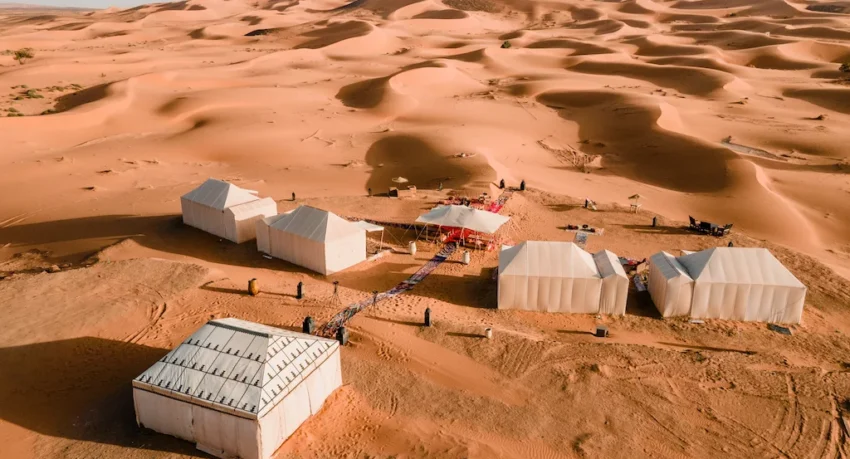
Tinjdad Morocco is one of the lesser-known destinations in the southeast of the country, offering travelers a quieter and more authentic experience between the High Atlas Mountains and the Sahara. Also commonly written as Tinejdad, the town is located in the Drâa-Tafilalet region and is surrounded by palm groves, traditional earthen villages as well as arid landscapes that reveal the character of the country’s southern oases.
Tinjdad Morocco
Many visitors pass through Tinjdad Morocco while traveling between Tinghir, the Todra gorge and the desert areas farther east. However, travelers who take the time to stop discover a fascinating oasis region with traditional architecture, Amazigh heritage and a slower rhythm of life. Tinjdad does not have the crowds of Marrakech, Fes or Morocco’s most famous desert destinations. That is part of its appeal. It provides an opportunity to experience a side of Morocco where palm plantations, mud-brick villages, local agriculture and centuries-old traditions remain closely connected to everyday life.
For travelers exploring southern Morocco with Typique Tours, Tinjdad Morocco can be an interesting cultural stop on the journey toward the Sahara. It is located in the southeast of the country, in Errachidia Province, within the Drâa-Tafilalet region. It is located on the route connecting the Tinghir area with destinations farther east toward the Tafilalet region and the Sahara. The town is approximately 50 kilometers from Tinghir according to regional references, making it a natural stop for travelers coming from the Todra gorge area.
This part of Morocco has a striking landscape. Rocky plateaus and dry mountains dominate the horizon, while green palm groves grow around sources of water. Traditional villages constructed from earth blend almost naturally into the surrounding landscape. The contrast between the green oasis and the dry terrain is one of the most memorable features of Tinjdad Morocco. Travelers following famous southern routes often pass through this area while journeying from Ouarzazate and the Dades Valley toward Tinghir, Erfoud and Merzouga.
The region therefore provides an interesting transition between the inspiring mountain valleys to the west and the increasingly desert-like landscapes farther east. One of the main reasons to visit Tinjdad Morocco is its oasis environment. Water has always determined where people could establish communities in Morocco’s arid southeast. Around Tinjdad, generations of inhabitants developed agricultural areas supported by traditional irrigation systems and carefully managed water resources.
Date palms are one of the most visible elements of the landscape. Beneath and around the palms, local farming has historically taken advantage of the shade and available water to create productive land in an otherwise dry environment. Walking around the oasis gives travelers a completely different experience from driving through the surrounding desert plains. Narrow paths pass between cultivated plots, palms rise above traditional houses and small irrigation channels show how water has been distributed through the landscape of Tinjdad Morocco.
These systems are an important part of the cultural identity of southern Morocco, and the Oasis Museum at nearby El Khorbat was established specifically to help preserve and explain this heritage. The most important cultural attraction around Tinjdad is Ksar El Khorbat Oujdid. A fortress is a traditional fortified settlement, usually constructed from local earthen materials. This area is particularly interesting because it remains a living settlement rather than simply an abandoned historical monument.
Ksar El Khorbat dates from around 1860 and was built using rammed earth. Its thick walls, towers and covered passages demonstrate architectural techniques designed for the climate of Tinjdad Morocco. Homes extend above some of the narrow passageways, helping keep the interior cooler during hot weather. Entering the fortress feels very different from walking through a modern Moroccan town. The light becomes softer inside the narrow passages, earthen walls rise on both sides and the layout reveals how traditional communities were organized within a protected settlement.
The architecture was practical as well as beautiful. Thick earthen walls helped protect residents from extreme temperatures, while compact construction created shaded areas and reduced exposure to the desert sun. El Khorbat is also significant because restoration efforts have helped preserve traditional buildings while supporting tourism and community activity. The village has been recognized internationally for initiatives connected to oasis heritage, restoration and local development.
Travelers who want to understand the history of the Tinjdad Morocco should spend time at the Oasis Museum inside Ksar El Khorbat, as it presents the traditions, architecture and daily life of local communities through collections displayed inside restored houses. Exhibits help visitors understand how people adapted to the demanding environment of southeastern Morocco. The museum includes objects connected with agriculture, domestic life, trade and traditional communities. It also provides information about the different groups and ways of life that shaped the region.
The museum is occupying 22 rooms and displaying objects connected with semi-nomadic life, traditional crafts and regional history. Visiting it before or after walking through the fortress makes the architecture easier to understand. Instead of seeing the settlement simply as an attractive collection of mud-brick buildings, visitors begin to understand how families lived, worked and organized themselves in an oasis environment.
Tinjdad Morocco is an excellent destination for travelers interested in traditional earthen architecture of the country. Across southern Morocco, communities developed remarkable construction techniques using materials available locally. Earth, straw, wood and stone were combined to build homes, defensive walls, towers and entire fortified villages. The warm brown and reddish colors of these buildings match the surrounding terrain, giving settlements the appearance of rising directly from the landscape.
Traditional fortresses were designed around the needs of the community. Narrow streets provided shade, thick walls helped regulate temperatures and fortified entrances offered protection. Although modern construction has changed many towns across Morocco, places around Tinjdad still provide an opportunity to see these architectural traditions. Culture is another important part. The region has deep Amazigh roots, and travelers will encounter a way of life shaped by oasis agriculture, family traditions, local markets and the demanding geography of southeastern Morocco.
The Amazigh identity of the south can be experienced through language, architecture, food, clothing and hospitality. For visitors of Tinjdad Morocco, some of the most meaningful experiences may be the simplest ones, including sharing tea, walking through an oasis, visiting a traditional village or learning how local families have used scarce water resources for generations. These experiences provide a very different perspective on Morocco from visiting only major tourist attractions.
Tinjdad Morocco is especially useful as part of a wider Sahara desert itinerary. Travelers leaving Marrakech commonly cross the High Atlas Mountains before continuing through Ouarzazate and the landscapes of southern Morocco. Many itineraries then travel through the Dades region and Tinghir before continuing east. Tinjdad is located naturally along this broader corridor toward the desert. This means a visit does not necessarily require a major detour. Instead, it can turn what might otherwise be a simple travel day into an opportunity to experience oasis culture and traditional architecture.
After Tinjdad Morocco, the scenery gradually becomes more arid as travelers continue toward the Tafilalet region and eventually the Sahara around Merzouga. The journey itself is one of the highlights of traveling through southern Morocco. Mountains, palm valleys, fortified villages, dry plateaus and desert scenery continually change along the road. Tinjdad also combines naturally with a visit to Tinghir and the Todra gorge. Tinghir is one of the best-known oasis towns in southeastern Morocco, while nearby Todra attracts travelers for its inspiring canyon walls and spectacular scenery.
After exploring Todra, travelers heading toward the Sahara can continue through the region toward Tinjdad. The change in scenery is gradual but noticeable. The high canyon landscapes around give way to wider valleys, palm groves and dry plateaus. Stopping at El Khorbat near Tinjdad adds an important cultural dimension to this journey. Instead of experiencing only the natural scenery, travelers can learn about the communities that have lived in these environments for generations.
Tinjdad Morocco can be visited throughout much of the year, but spring and autumn are particularly pleasant because temperatures tend to be more comfortable for walking around the oasis and exploring traditional settlements. Summer temperatures in southeastern Morocco can become intense, making sightseeing during the middle of the day less comfortable. Winter can also be an attractive period for traveling through southern Morocco. Days may be pleasantly mild, although mornings, evenings and nights can become cold.
Travelers should remember that the climate in this region can vary significantly between daytime and nighttime. Whenever you visit, comfortable walking shoes, sun protection and drinking water are useful, especially if you plan to explore the palm groves and traditional villages on foot. Tinjdad Morocco is worth visiting for travelers who enjoy cultural experiences, historic architecture and places that remain outside Morocco’s busiest tourism circuits.
It is not a destination filled with major monuments or large tourist attractions. Instead, its appeal comes from the landscape and the connection between the oasis, traditional settlements and local life. Ksar El Khorbat alone makes the area an interesting stop, particularly for travelers curious about southern fortified villages and oasis culture. Tinjdad Morocco also provides a welcome change of pace during a longer Morocco road trip. After visiting famous destinations, spending time in a quieter oasis community can reveal another side of the country.
For most travelers, several hours can be enough to explore Ksar El Khorbat, visit the Oasis Museum and experience part of the surrounding palm oasis. Those who enjoy photography, architecture or slow travel may prefer to stay longer in Tinjdad Morocco. An overnight stay allows you to experience the area when day visitors have moved on and temperatures become cooler. Early morning and late afternoon are particularly attractive times to explore the oasis landscape.
This region can work either as a worthwhile stop between major destinations or as a peaceful overnight destination on a longer journey through southern Morocco. Tinjdad Morocco offers something increasingly valuable to travelers, which is the opportunity to slow down and discover a destination through its landscape, architecture and local heritage. Here, the attraction is not a single famous monument, but the combination of palm groves surrounded by dry mountains, centuries-old earthen construction, traditional oasis communities and the feeling of traveling through one of Morocco’s most distinctive regions.
A visit to Ksar El Khorbat provides an excellent introduction to the architecture of southern Morocco, while the Oasis Museum helps explain how communities adapted to life in an arid environment. The surrounding landscape completes the experience, showing how water, agriculture and settlement have always been closely connected. For travelers continuing toward the Sahara, Tinjdad Morocco is also perfectly positioned as part of the journey. It provides a cultural pause between the mountain landscapes around Tinghir, Todra and the increasingly desert scenery farther east.
With Typique Tours, Tinjdad can be included as part of a private Morocco desert tour or a longer journey through the south. Combining historic villages, oasis landscapes, mountain valleys, in addition to the Sahara creates a richer experience than simply traveling from one famous destination to another. If you want to discover a quieter and more traditional side, Tinjdad Morocco is a destination worth considering. It may be less famous than Marrakech or Merzouga, but its palm oasis, Amazigh heritage and remarkable earthen architecture offer an authentic glimpse into the history and culture of Morocco’s southeast.