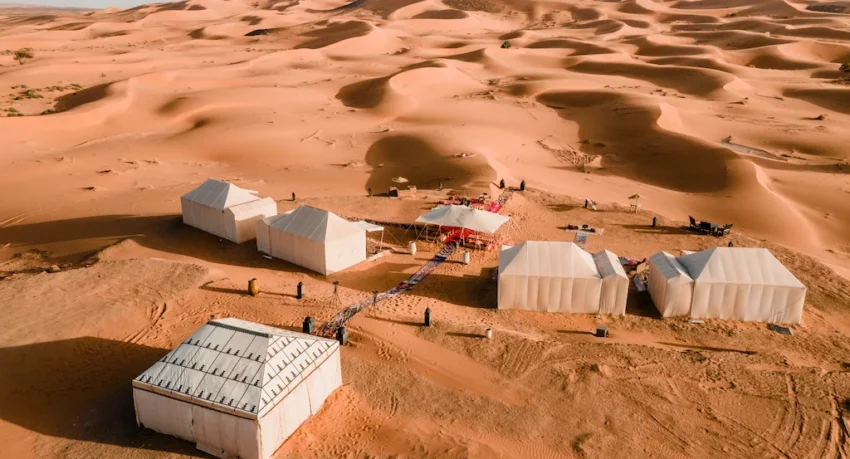
Tinjdad is a peaceful oasis town in southeastern Morocco, surrounded by palm groves, traditional earthen villages and the dry landscapes of the Drâa-Tafilalet region. Also commonly written as Tinejdad, it sits along the road connecting Tinghir with Errachidia and the Tafilalet region, making it a natural stop for travelers heading toward the Sahara Desert. Unlike Marrakech, Fes or Merzouga, Tinjdad is not a destination built around large tourist attractions. Its appeal is quieter.
Tinjdad
Travelers come here to discover traditional oasis life, walk through historic fortified villages, learn about Amazigh culture and experience a part of Morocco where agriculture, water and architecture have been closely connected for generations. For visitors traveling with Typique Tours through southern Morocco, Tinjdad can add an interesting cultural stop between the inspiring landscapes around Todra gorge and the desert regions farther east.
Tinjdad is located in Errachidia Province in Morocco’s Drâa-Tafilalet region, on the N10, approximately 50 kilometers from Tinghir depending on the exact route. This position places the town along one of the classic travel corridors through southeastern Morocco. Travelers approaching from Marrakech often reach this region after crossing the High Atlas Mountains and continuing through Ouarzazate, the Valley of the Roses, Dades and Tinghir. From Tinjdad, the journey can continue toward Erfoud, Rissani and eventually the dunes around Merzouga.
The scenery surrounding Tinjdad immediately shows why settlements developed here. Dry plains and rocky hills dominate much of the landscape, yet areas supplied with water support green palm groves and cultivated land. This contrast between fertile oasis and arid countryside gives Tinjdad much of its character. The oasis is one of the most important features. In southeastern Morocco, water has always determined where communities could survive. Oasis settlements developed around springs, wells and irrigation networks that allowed families to grow crops despite the dry climate.
Around Tinjdad, palm trees create shaded areas above cultivated plots. Traditional paths pass between gardens and earthen houses, offering visitors the chance to see how agricultural life has adapted to the environment. The landscape can be particularly attractive in the morning or late afternoon, when lower sunlight brings out the colors of the palms, fields and mud-built villages. Exploring an oasis on foot also gives travelers time to notice details that are easy to miss from a vehicle.
Irrigation channels, small agricultural plots, traditional houses and date palms reveal how local communities transformed a difficult landscape into productive land. This relationship between people, architecture and water is one of the most interesting themes of a visit to Tinjdad. The best-known historic attraction is Ksar El Khorbat. It is a fortified settlement traditionally built to house families within a protected group of structures. Ksar El Khorbat is a remarkable example of this type of architecture and remains closely connected to local life.
The settlement was built in the nineteenth century using traditional earthen construction techniques. Its tall walls, defensive towers and narrow interior passages create an atmosphere that feels very different from Morocco’s modern towns. Inside the fortress, sections of the lanes are covered by buildings above them. This design helps protect inhabitants from the intense sun and keeps the passageways cooler. Walking through El Khorbat provides an excellent introduction to the architecture of southern Morocco.
Rather than seeing a reconstructed tourist attraction, visitors can explore an environment shaped by practical needs, climate and community organization. Ksar El Khorbat also received international recognition when it was named among the UN World Tourism Organization’s Best Tourism Villages for 2022. The initiative highlighted its preservation of oasis traditions, historic architecture, traditional water-management systems and community-based tourism.
Another highlight of a visit to the Tinjdad area is the Oasis Museum at Ksar El Khorbat, helping visitors understand what they are seeing throughout the region. Exhibitions explore local society, architecture, agriculture, traditional objects and the history of communities living in southeastern Morocco. This is particularly useful because many aspects of oasis life may not be immediately obvious to an outside visitor. A water channel, farming tool or building technique can have a much deeper meaning once its role in local life is understood.
The museum forms part of wider efforts to protect and explain the heritage of oasis civilization. According to the Best Tourism Villages program, the project also supports preservation of local traditions and awareness of agricultural and environmental systems. For travelers interested in Moroccan culture rather than simply taking photographs, the museum makes Ksar El Khorbat one of the most worthwhile stops around.
Tinjdad has another interesting cultural attraction, which is the Museum of the Sources of Lalla Mimouna. It is one of the cultural sites worth visiting in the wider Errachidia, Midelt and Merzouga region. Its collection reflects everyday life in the desert and oasis areas of southeastern Morocco. Traditional tools, pottery, textiles and other objects help tell the story of local communities and their relationship with the surrounding environment. The museum is also integrated with an outdoor garden setting.
For visitors making a longer stop in Tinjdad, combining this museum with El Khorbat provides a broader understanding of local history. One of the most distinctive features of the surrounding region is its earthen architecture. For centuries, communities in southern Morocco built houses, towers and defensive structures from materials available locally. Earth was particularly well suited to the environment because thick walls could help moderate the extreme differences between daytime heat and cooler nights.
The reddish-brown colors of these buildings also blend naturally with the surrounding landscape. Traditional fortresses were designed as compact communities. Narrow streets provided shade, walls offered protection and homes were arranged in ways that responded to both climate and social life. Many travelers first encounter this architectural style around Ouarzazate or Ait Ben Haddou, but Tinjdad offers the chance to see similar traditions in a quieter setting with fewer visitors.
Tinjdad is deeply connected to the Amazigh heritage of southeastern Morocco. The region’s culture can be experienced through language, food, traditional clothing, architecture, farming techniques and hospitality. Although modern life continues to change the town, villages around Tinjdad still preserve aspects of a way of life shaped by the oasis environment. Some of the most memorable experiences are often simple ones. Walking with a local guide through a palm grove, drinking mint tea, visiting a traditional home or learning how irrigation works can reveal more about the region than quickly visiting several monuments.
Traveling slowly through Tinjdad also offers a chance to see southern Morocco as a living region rather than simply as scenery on the road to the Sahara. Tinjdad is especially convenient for travelers following a Morocco desert tour. To the west you can find Tinghir and the spectacular Todra gorge. To the east, roads continue toward Goulmima, Erfoud, Rissani and the Sahara around Merzouga. This makes Tinjdad a natural bridge between two very different landscapes.
Around Todra, travelers encounter inspiring canyon walls, mountain scenery and a long green oasis. Farther east, the environment becomes progressively drier as the journey approaches the Tafilalet and Sahara regions. Tinjdad sits between these worlds. Stopping here can break up a driving day while adding a cultural experience to an itinerary that might otherwise focus mainly on landscapes. The region also fits naturally into a journey along Morocco’s famous southern fortresses routes.
The wider region stretching from Ouarzazate toward Tinghir and the desert is known for fortified villages, earthen fortresses and valleys surrounded by striking mountain scenery. Morocco’s National Tourist Office promotes this part of the country for its combination of oasis landscapes, traditional fortified settlements and desert gateways. Traveling through the region gradually reveals how architecture changes according to geography.
Some villages are built beside river valleys, others rise above palm groves, while communities farther toward the Sahara developed around wells and historic trade routes. Tinjdad is a good place to slow down and appreciate this connection between settlement and landscape. Tinjdad is worth visiting if you enjoy places that are quieter, culturally interesting and less dominated by mass tourism. Travelers expecting a long list of famous monuments may find the town understated. Tinjdad’s real appeal is in the experience of the oasis, nearby fortresses and local heritage.
Ksar El Khorbat makes the area particularly worthwhile. Its preserved earthen architecture, inhabited spaces and Oasis Museum give visitors much more context about southern Moroccan life than a quick roadside stop normally provides. Tinjdad can also be a welcome contrast after spending time at busier destinations. Instead of crowded medinas and major attractions, you can explore palm groves, discover traditional architecture and experience the slower rhythm of an oasis community.
Travelers following a busy desert itinerary can discover the main attractions around Tinjdad in several hours. A visit to El Khorbat, the Oasis Museum and part of the surrounding oasis can comfortably fit into a journey between Tinghir and the Sahara. However, travelers interested in photography, architecture or local culture may want to spend a night. Staying longer allows you to experience the area during early morning and evening, when temperatures are often more comfortable while the light across the earthen buildings as well as palm groves can be especially beautiful.
An overnight stay also changes the character of the visit. Instead of treating Tinjdad simply as a stop along the road, you have more time to appreciate its quiet atmosphere. Spring and autumn are excellent periods for visiting Tinjdad because temperatures are generally more comfortable for walking and sightseeing. Winter can also be pleasant during the day, though mornings and evenings may feel cold. Summer is considerably hotter in southeastern Morocco. Travelers visiting during the warmer months may prefer to explore outdoor attractions early in the morning or later in the afternoon.
Regardless of the season, sun protection, water and comfortable footwear are useful when walking through the oasis or traditional villages. Tinjdad may not be one of the first names travelers recognize when planning a trip to Morocco, but that is exactly what makes it interesting. It offers the chance to discover a landscape shaped by water, agriculture and generations of human adaptation. Green palm groves rise against dry plains, historic earthen settlements preserve traditional architecture and local museums explain the culture that developed around these oases.
Ksar El Khorbat is the highlight for many visitors, combining history, architecture and living heritage in one remarkable fortified village. Its international recognition for rural tourism and heritage preservation reflects the importance of protecting these communities for future generations. For travelers continuing toward Merzouga, Tinjdad is also ideally positioned between the Todra region and the beautiful Sahara desert.
A stop here transforms the journey from a simple transfer into another part of the Morocco experience. With Typique Tours, Tinjdad can be included in a private desert tour through the Moroccan south, alongside destinations such as Ouarzazate, Dades Valley, Tinghir, Todra Gorge, Erfoud, Rissani and Merzouga. Whether you spend a few hours exploring El Khorbat or stay longer to experience the oasis at a slower pace, Tinjdad offers an authentic glimpse into the landscapes and traditions of southeastern Morocco.